Coastal & Natural Configurations Tested
What it means?
This KPI reflects the breadth of scientific evaluation undertaken during the research phase of the TATrakshak initiative. Before advancing the Tripot design, more than sixteen coastal configurations—including natural shorelines, conventional hard structures, and hybrid ecological systems—were systematically analysed under controlled hydraulic conditions.
The evaluation included:
•Natural shoreline conditions for baseline comparison.
•Conventional coastal structures such as seawalls and revetments.
•Measurement of wave run-up, overtopping, and energy dissipation across all cases

Tons CO₂ Reduction per km per Year
~800–1,200 Tons CO₂ Reduction per km per Year
Each kilometer of deployment functions as climate-positive coastal infrastructure by integrating mangrove-driven blue-carbon sequestration, long-term sediment carbon storage, and low-emission material systems. This approach transforms shoreline protection into a measurable climate asset, delivering verifiable environmental performance alongside durable coastal resilience.
• Direct contribution to national NDCs, net-zero goals, and ESG commitments
• Eligibility for climate finance, carbon programs, and sustainability-linked funding
• Conversion of environmental impact into measurable, reportable carbon value
• Support for long-term coastal resilience and adaptation planning

Mangrove Survival Rate (Field-Validated)
High Mangrove Survival in Dynamic Tidal Zones
The integration of biological design elements enables consistently high survival of mangrove saplings even under dynamic tidal and wave conditions, significantly outperforming conventional plantation approaches.
• Enables scalable nature-based solutions aligned with national missions such as MISHTI and the Blue Economy
• Structural planting chambers designed to support seedling stability
• Creates living assets that continue to generate value through carbon capture, fisheries support, and ecosystem services
• Enables ecological restoration within engineered coastal infrastructure

Reduction in Wave Run-Up (Lab-Validated)
What it demonstrates
The Tripot system significantly reduces wave run-up and overtopping by dissipating wave energy instead of reflecting it, lowering direct impact on the shoreline and hinterland.
Why it matters for B2G
• Directly reduces flooding risk
• Improves safety of coastal assets and communities
• Supports disaster-risk-reduction objectives
Why it matters for B2B
• Lower structural stress → longer asset life
• Reduced maintenance liability
• Predictable performance under design storms

Lower Embodied CO₂ through GreenMix Concrete
What it demonstrates
Material-level innovation reduces emissions at the construction stage itself, not only during operation.
Why it matters for EPC & Infra Firms
• Compliance with emerging low-carbon procurement norms
• Reduced exposure to future carbon taxation
Why it matters for governments
• Aligns with net-zero construction policies
• Sets benchmark for sustainable public infrastructure
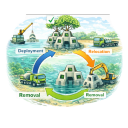
Reusability across the Infrastructure Lifecycle
What it demonstrates
Unlike conventional coastal structures, Tripot units are designed for repair, relocation, and redeployment — enabling circular infrastructure.
Why it matters for B2G
• Lower lifecycle expenditure
• Reduced demolition and waste management burden
Why it matters for B2B
• Asset flexibility
• Higher return on invested capital over time
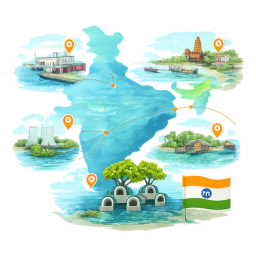
India’s Addressable Coastal Market
₹25,000–60,000 Crore National Addressable Market (India)
India has approximately 7,517 km of coastline, of which an estimated 34–36% is affected by erosion. Priority intervention zones account for nearly 2,500 km, where immediate and long-term protection is required.
• Large-scale opportunity aligned with national coastal resilience and adaptation priorities
• Clear visibility of demand concentrated in high-risk erosion zones
• Long-term public infrastructure spending with multi-decade service horizons
• Strong fit for sustainable, low-carbon, and nature-integrated protection systems

Physical Scale Modeling
1:50 Physical Scale Modeling
A 1:50 physical scale model was developed to replicate real coastal conditions within a laboratory flume environment, enabling controlled observation of wave interaction, run-up behaviour, and structural response before full-scale deployment considerations.
• Conducted using Froude-scaled hydraulic modelling principles
• Enabled controlled measurement of wave run-up and overtopping
• Provided a scientific baseline for validating Tripot performance

Global Coastal Protection Marke
USD 300–800 Billion Global Addressable Market
Globally, nearly 100,000 km of coastline is vulnerable to erosion, flooding, and storm surge. At an average protection cost of USD 3–8 million per km, this translates into a global addressable market of USD 300–800 billion for resilient coastal protection solutions.
• Large, climate-driven infrastructure demand
• Long-term deployment across high-risk coastal regions
• Opportunity across government, infrastructure, and climate resilience programs
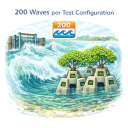
Waves per Test Configuration
200 Waves per Test Configuration
Each model configuration was subjected to 200 controlled wave cycles, providing statistically reliable performance data and ensuring repeatability in assessing stability, energy dissipation, and overtopping behavior.
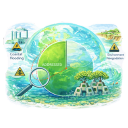
Global Coastal Problems Addressable
Addresses ~75–80% of Global Coastal Challenges
Wave-induced erosion, coastal flooding, sediment imbalance, and ecosystem degradation together account for an estimated 75–80% of global coastal problems, as seen in eroding shorelines of Odisha and Kerala, recurrent flooding in the Sundarbans and Mekong Delta, sediment starvation near ports and seawalls worldwide, and widespread mangrove loss across tropical coasts. TATrakshak directly targets these challenges by dissipating wave energy, stabilizing sediments, and restoring coastal ecosystems, enabling integrated protection rather than isolated structural fixes.
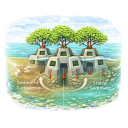
Improved Sediment Stability
Hybrid geometry and nature-integrated design encourage sediment deposition instead of scouring, helping rebuild the seabed and support long-term shoreline stabilization under everyday wave and tidal conditions.

Hectares of Ecosystem Restored per km
6–12 Hectares of Ecosystem Restored per km
Each kilometer of Tripot deployment enables large-scale mangrove and riparian ecosystem restoration, strengthening natural coastal buffers and enhancing long-term resilience.
• Rebuilds natural wave and storm-surge protection systems
• Enhances carbon sequestration and biodiversity recovery
• Improves sediment retention and shoreline stability

Biodiversity Improvement (Target)
20–30% Biodiversity Improvement (Target)
Reduced turbulence and habitat-forming geometry create favorable conditions for the return of marine flora and fauna, supporting gradual biodiversity recovery over time.
• Creation of micro-habitats for fish, crustaceans, and benthic species
• Improved ecological connectivity along the shoreline
• Strengthening of local food chains and ecosystem balance
Lifecycle Cost Reduction
25–35% Lifecycle Cost Reduction
Lower maintenance requirements, reuse potential, and ecological co-benefits together reduce total lifecycle costs by an estimated 25–35% compared to conventional hard coastal protection solutions.
• Reduced long-term maintenance and repair expenditure
• Extended service life through lower structural stress
• Added value from ecological and climate co-benefits
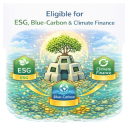
ESG, Blue-Carbon & Climate Finance
Eligible for ESG, Blue-Carbon & Climate Finance
The project aligns with key global and national frameworks including UN SDGs (9, 11, 13, 14), MISHTI, and the Blue Economy, enabling access to ESG-linked capital, blue-carbon mechanisms, and climate finance.
• Supports compliance with global sustainability and disclosure standards
• Unlocks blended finance and results-based funding opportunities

From Local Pilots to Global Replicatione
Scalable from Local Pilots to Global Replication
The system is designed to scale seamlessly from 200-meter pilot installations to multi-kilometer deployments, with modular units that can be locally manufactured and adapted to diverse coastal and climatic conditions worldwide.
• Enables phased implementation and rapid scale-up
• Reduces logistics and cost through local production
• Adaptable across varied geographies and wave climates
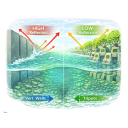
Lower Reflection Coefficient than Vertical Walls
Lower Reflection Coefficient than Vertical Walls
Unlike rigid vertical seawalls that reflect wave energy back into the water column, the Tripot system dissipates wave energy more naturally, reducing reflected forces, downstream erosion, and secondary coastal damage.
• Minimizes wave rebound and scour near structures
• Improves overall shoreline and seabed stability